
Color Grid Logic Puzzle
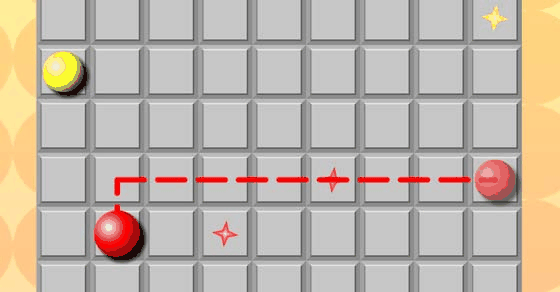
Color Grid Logic Puzzle asks players to align five or more matching balls in a row. Each move adds new pieces, making the grid progressively harder to manage. Success depends on careful planning and quick pattern spotting.
Reviews
About this game
The Core Objective
At its heart, Color Grid Logic Puzzle is about forming straight lines of five or more identical colored balls. These lines can run horizontally, vertically, or diagonally across the board. When a line is completed, the balls vanish and the player earns points. The challenge comes from the fact that after every move, three new balls appear at random positions on the grid. This constant influx of pieces forces players to think several steps ahead, balancing immediate gains with long-term board management.
Growing Difficulty Curve
The game starts with a nearly empty grid, giving players room to maneuver. As the board fills up with each turn, the available empty spaces shrink. Players must decide whether to clear a line quickly to free up space or hold out for a larger combo. The random placement of new balls ensures that no two games play out the same way. This unpredictability keeps the experience fresh and encourages repeated attempts to improve one's score.
Visual Design and Accessibility
The interface uses bright, distinct colors for each ball type, making it easy to identify matches at a glance. The clean layout minimizes distractions, allowing players to focus on the puzzle. The controls are straightforward: click a ball to select it, then click an adjacent empty cell to move it. This simplicity makes the game accessible to players of all ages, while the underlying strategy offers depth for more experienced puzzle enthusiasts.
Endless Replay Value
Because the game has no fixed levels or endpoints, each session presents a unique challenge. The scoring system tracks high scores, giving players a clear goal to beat. The combination of simple rules and complex outcomes creates a satisfying loop that works well for both short breaks and extended play sessions. The game rewards consistent practice, as pattern recognition and spatial planning improve over time.
Strategic Considerations
Effective play involves more than just spotting existing lines. Players must anticipate where new balls might land and plan moves that keep the board open. Focusing on clearing balls near the edges can create more room in the center. Avoiding clusters of different colors in one area helps prevent the grid from becoming blocked. With patience, players can develop strategies that lead to longer games and higher scores.





Comments
0 comments